Photonics & Optics
UK Photonics, Optics & Laser Hiring Market 2026
The UK photonics industry is substantial, but specialist engineering talent remains scarce. Humand analyses specialist supply, adjacent talent pools, skills, locations and what employers should consider when hiring.
- 13 sections
- Published September 2026
The market at a glance
- £18.5bn
- UK photonics turnover in 2024
- 84,800
- people employed across the UK photonics industry
- 1,400+
- UK businesses operating across photonics and related technologies
- 509
- professionals in Humand's tightly defined UK specialist talent pool
- 83
- recent job movers identified within that specialist pool
- 31
- relevant job posts identified in the same defined market
The first three figures come from current UK photonics industry reporting. The final three are from Humand's own defined 2026 talent-market analysis and should be read as a specialist market sample, not a national workforce census.
What this report finds
- The UK photonics market is substantial. The specialist talent pool is not.
- The biggest hiring mistake is searching too literally
- There is a wider engineering market around the 509-person specialist pool
- The capability stack matters more than a list of keywords
- Oxford and Cambridge are important — but they are not the whole market
- Your competitors for talent may not look like your competitors for customers
Contents — 13 sections
- The UK photonics market is substantial. The specialist talent pool is not.
- The biggest hiring mistake is searching too literally
- There is a wider engineering market around the 509-person specialist pool
- The capability stack matters more than a list of keywords
- Oxford and Cambridge are important — but they are not the whole market
- Your competitors for talent may not look like your competitors for customers
- Passive talent matters in specialist engineering
- Employers should be prepared to challenge the original job description
- What should employers assess?
- What this means for hiring teams
- Methodology and limitations
- Sources
- Hiring photonics, optics or laser engineers?
What employers need to know about talent availability, skills and hiring in one of the UK's most specialist engineering markets
The UK has a significant and growing photonics industry, but the people needed to build, test and commercialise optical technologies remain highly specialised.
For employers, that creates an important distinction.
There is a healthy UK technology ecosystem around photonics, lasers, optics, scientific instrumentation and advanced engineering. But the number of people with the exact combination of scientific depth, systems capability and commercial experience required for many roles is relatively small.
Humand's 2026 market analysis identified 509 UK professionals in a tightly defined specialist talent pool covering laser engineering, photonics, optical engineering, optical microscopy and optical metrology.
Within that pool, 83 had recently changed jobs, while 31 relevant job posts were identified within the same defined market.
That does not mean only 509 people in the UK can work in photonics.
It means the obvious specialist market becomes small very quickly — and employers that search only for exact job titles or direct competitors risk missing a much wider group of capable engineers.
The UK photonics market is substantial. The specialist talent pool is not.
Photonics now supports industries far beyond traditional optics.
The UK's photonics sector produced goods and services worth £18.5 billion in 2024, according to current UK photonics industry reporting.
The sector supports applications across areas including:
- quantum technologies;
- semiconductors;
- defence and aerospace;
- medical devices and imaging;
- advanced manufacturing;
- sensing and instrumentation;
- scientific equipment;
- communications;
- autonomous systems.
That breadth is good news for the UK technology economy.
For employers, however, it means the same specialist engineers are attractive to several very different industries.
An optical engineer working in defence may have capabilities relevant to quantum.
A metrology engineer in semiconductor equipment may be relevant to scientific instrumentation.
A systems engineer in medical imaging may have experience that transfers into high-precision optical products.
The competition for talent therefore extends well beyond businesses that describe themselves as photonics companies.
The biggest hiring mistake is searching too literally
Photonics is a market where job titles can be misleading.
Humand's market analysis found that the core specialist population includes obvious titles such as:
- Optical Engineer
- Senior Optical Engineer
- Laser Engineer
- Metrology Engineer
But the relevant talent market also includes:
- System Engineer
- Senior System Engineer
- Lead System Engineer
- Control Engineer
- Mechatronics Engineer
- Mechanical Engineer
- Physicist
- Research Physicist
- Technical Lead
For many searches, a candidate's capability matters considerably more than the wording of their current job title.
A business looking for an Optical Systems Engineer, for example, may find suitable people working under systems, instrumentation, physics or product-development titles.
This is one reason specialist hiring can appear harder than it really is.
The talent exists, but it is not always labelled in the way the hiring brief expects.
There is a wider engineering market around the 509-person specialist pool
Humand also mapped a broader commercial-engineering layer around the core optics and photonics market.
That wider group contained approximately 808 UK professionals across relevant areas such as:
- systems engineering;
- mechanical engineering;
- controls;
- mechatronics;
- metrology;
- manufacturing engineering;
- technical leadership.
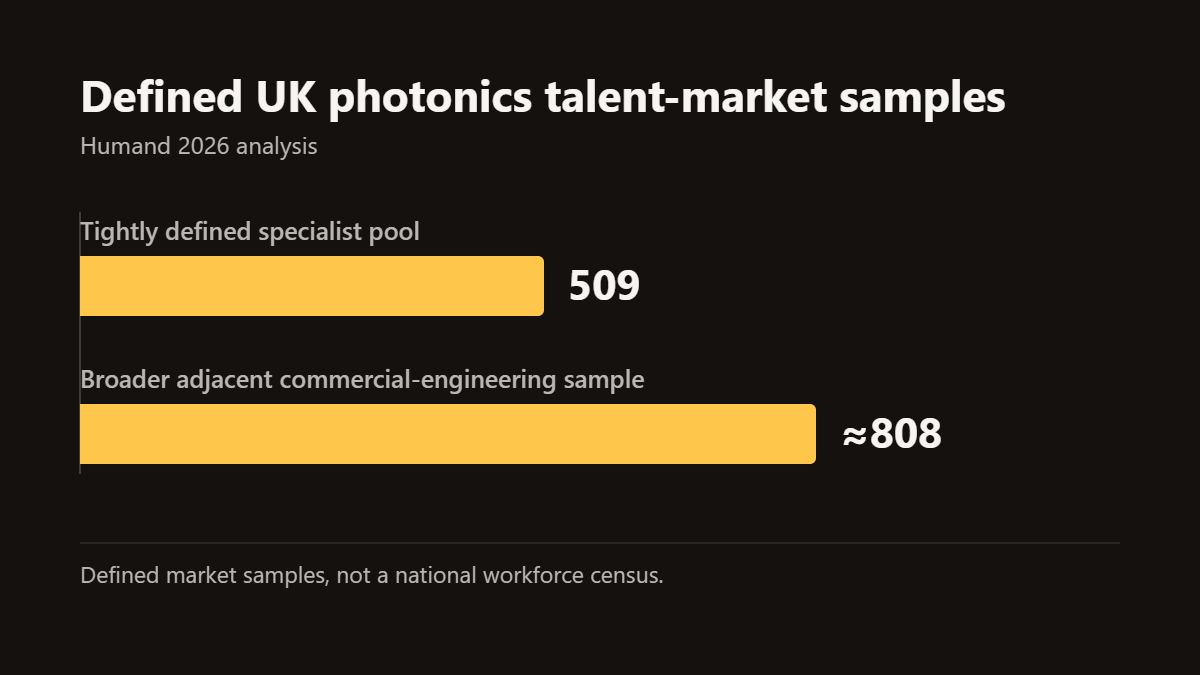
What this chart shows
Humand's 2026 analysis identified 509 UK professionals in a tightly defined specialist pool covering laser engineering, photonics, optical engineering, optical microscopy and optical metrology. A separate broader commercial-engineering analysis covered approximately 808 professionals across adjacent systems, mechanical, controls, mechatronics, metrology and leadership roles. The broader defined sample is larger. These figures are defined talent-market samples, not a national workforce census.
This matters because not every vacancy genuinely needs somebody who has already performed the exact role in the exact sector.
Employers should separate what genuinely needs to be present on day one from what an experienced engineer can learn once they join.
For some positions, deep optical science is non-negotiable.
For others, the more valuable capability may be systems integration, measurement, test, manufacturing, controls or the ability to translate scientific concepts into a reliable commercial product.
That distinction can dramatically change the available talent pool.
The capability stack matters more than a list of keywords
Humand's analysis groups strong commercial photonics talent across four overlapping capability layers.
1. Science and optical fundamentals
This can include:
- optics;
- photonics;
- physics;
- lasers;
- optical design.
These capabilities are often essential where the engineer is working directly with the underlying physical principles of the product.
2. Systems translation
Strong commercial engineers often need to translate that scientific foundation into a complete working system.
Relevant capabilities can include:
- systems engineering;
- electro-optics;
- modelling;
- controls;
- system integration.
This is where technically impressive prototypes begin becoming usable products.
3. Test, measurement and validation
High-precision products require disciplined measurement.
That can include:
- metrology;
- calibration;
- test and measurement;
- validation;
- repeatability;
- failure analysis.
These capabilities become particularly important in sectors such as semiconductor equipment, scientific instrumentation, medical devices and defence.
4. Manufacturing and product delivery
Commercial success ultimately requires more than a functioning experiment.
Employers may also need experience in:
- design for manufacture;
- reliability;
- quality;
- supplier management;
- production engineering;
- product delivery.
A technically exceptional scientist is not automatically the right person to industrialise a product.
Likewise, an engineer without a photonics title may be extremely valuable if they have repeatedly taken complex hardware from development into production.
Oxford and Cambridge are important — but they are not the whole market
Oxford and Cambridge naturally feature heavily in UK deep-tech hiring.
Both ecosystems combine universities, spinouts, scientific research, quantum, photonics, instrumentation and advanced engineering.
That concentration creates access to unusually strong technical talent.
It also creates competition.
An engineer in Oxford may be considering opportunities across quantum computing, medical imaging, autonomous systems, semiconductor technology, scientific instrumentation and software-intensive engineering at the same time.
Humand's research also identified useful specialist talent outside the most obvious South East clusters, including Scotland.
For hard-to-fill searches, geography should form part of the talent-mapping exercise rather than being decided purely from the office postcode.
Your competitors for talent may not look like your competitors for customers
One of the strongest findings from the market analysis is how widely relevant engineering capability is distributed.
The same engineers may be employed across:
- defence and space;
- quantum;
- semiconductors and electronics;
- medical equipment;
- aerospace;
- advanced technology;
- optical systems;
- scientific instrumentation.
If a photonics company only approaches people employed by other photonics companies, it may unnecessarily shrink the market before the search has even begun.
A better starting point is where does the capability we need actually exist? rather than which companies look most like us?
Passive talent matters in specialist engineering
In small technical markets, advertising alone rarely gives a complete picture.
Many of the strongest engineers are:
- already employed;
- not actively applying;
- known within specialist communities;
- working under adjacent titles;
- reasonably happy where they are.
That changes the recruitment challenge.
The task becomes a combination of:
- accurate market mapping;
- role calibration;
- identifying adjacent backgrounds;
- approaching passive talent;
- explaining the technical proposition;
- managing a focused interview process;
- closing a candidate who may have several credible alternatives.
Employers should be prepared to challenge the original job description
When a search struggles, the answer is not always to advertise the same specification more widely.
Is every requirement genuinely essential?
A brief containing optics, systems engineering, Python, electronics, metrology, manufacturing, leadership experience and an exact industry background may describe an excellent candidate.
It may also describe almost nobody.
Can domain knowledge be trained?
An engineer with excellent systems, controls or measurement experience may be able to learn the company's optical domain faster than an optical specialist can learn years of product-development discipline.
Are we using the right titles?
The person you want may currently be called a Systems Engineer rather than an Optical Engineer.
Are we offering a compelling technical problem?
Scarce engineers need a reason to move.
The quality of the technical challenge, product, leadership team, autonomy and career opportunity can be as important as job title.
Is the interview process proportionate?
A niche candidate market does not remove the need for rigorous assessment.
It does mean unnecessary stages and slow decisions can become expensive.
What should employers assess?
Scientific understanding. Can the person explain the physics and engineering principles behind their work?
Systems thinking. Can they understand interactions between optics, electronics, mechanics, software and controls?
Test and measurement discipline. How do they validate performance, understand uncertainty and investigate failure?
Commercial engineering judgement. Can they make sensible trade-offs between technical perfection, cost, reliability, manufacturability and delivery?
Ownership. What have they personally designed, built, validated or delivered?
Communication. Can they work effectively with scientists, engineers, suppliers, customers and non-specialist stakeholders?
For senior roles in particular, employers should test for the ability to convert deep technical expertise into decisions and delivery.
What this means for hiring teams
The UK has a credible and important photonics talent base.
The challenge is not that good engineers do not exist.
The challenge is that the obvious specialist pool is relatively small and the strongest candidates are spread across sectors, titles and technologies.
For employers, effective hiring strategies will usually:
- define the capability before defining the title;
- distinguish essential domain knowledge from trainable knowledge;
- map adjacent sectors before assuming the market is empty;
- search beyond direct competitors;
- engage passive candidates rather than relying only on applications;
- build a strong technical and commercial reason to move;
- run a focused, credible and timely interview process.
In specialist engineering, better market definition can be more valuable than simply increasing sourcing volume.
Methodology and limitations
This article combines current public UK industry sources with Humand Talent's own 2026 market intelligence.
Humand's specialist analysis used a defined UK talent population covering laser engineering, photonics, optical engineering, optical microscopy and optical metrology.
Within that defined specialist pool, Humand identified:
- 509 relevant professional profiles;
- 83 recent job movers;
- 31 relevant job posts.
A separate broader commercial-engineering analysis covered approximately 808 professionals across adjacent systems, mechanical, controls, mechatronics, metrology and leadership roles.
Humand also reviewed a wider international benchmark across the UK, United States and Germany.
These figures represent a defined talent-market analysis, not an official census of every person capable of working in photonics.
Job titles, profile terminology and market data are imperfect. The purpose of the analysis is to help employers understand the shape of the available market and make better hiring decisions rather than claim an exact national workforce count.
Sources
- UK Photonics Leadership Group, UK Photonics 2025: The Hidden Economic Engine (June 2025) — £18.5bn output in 2024, 84,800 people employed, and the UK photonics company base.
- Council for Science and Technology, CST advice on growth and global leadership in photonics (GOV.UK, 9 March 2026) — government-hosted restatement of the £18.5bn turnover figure and the sector's growth outlook.
- Institution of Engineering and Technology, Latest UK engineering and technology skills stats 2025 (6 October 2025) — 76% of engineering employers struggle to recruit for key roles.
- EngineeringUK, The Engineering and Technology Workforce (April 2026) — approximately 6.3 million people work in engineering and technology occupations, around a fifth of the UK workforce, on 2025 Labour Force Survey data.
Hiring photonics, optics or laser engineers?
Humand Talent works with technology and deep-tech businesses hiring specialist engineers across photonics, optics, lasers, instrumentation, metrology, software and technical leadership.
We help employers define the market, identify where the relevant capability sits and engage people who may never respond to a conventional job advert.
Talk to Humand about your next specialist engineering hire.
More Humand market intelligence is published in our reports library.